
Design Science
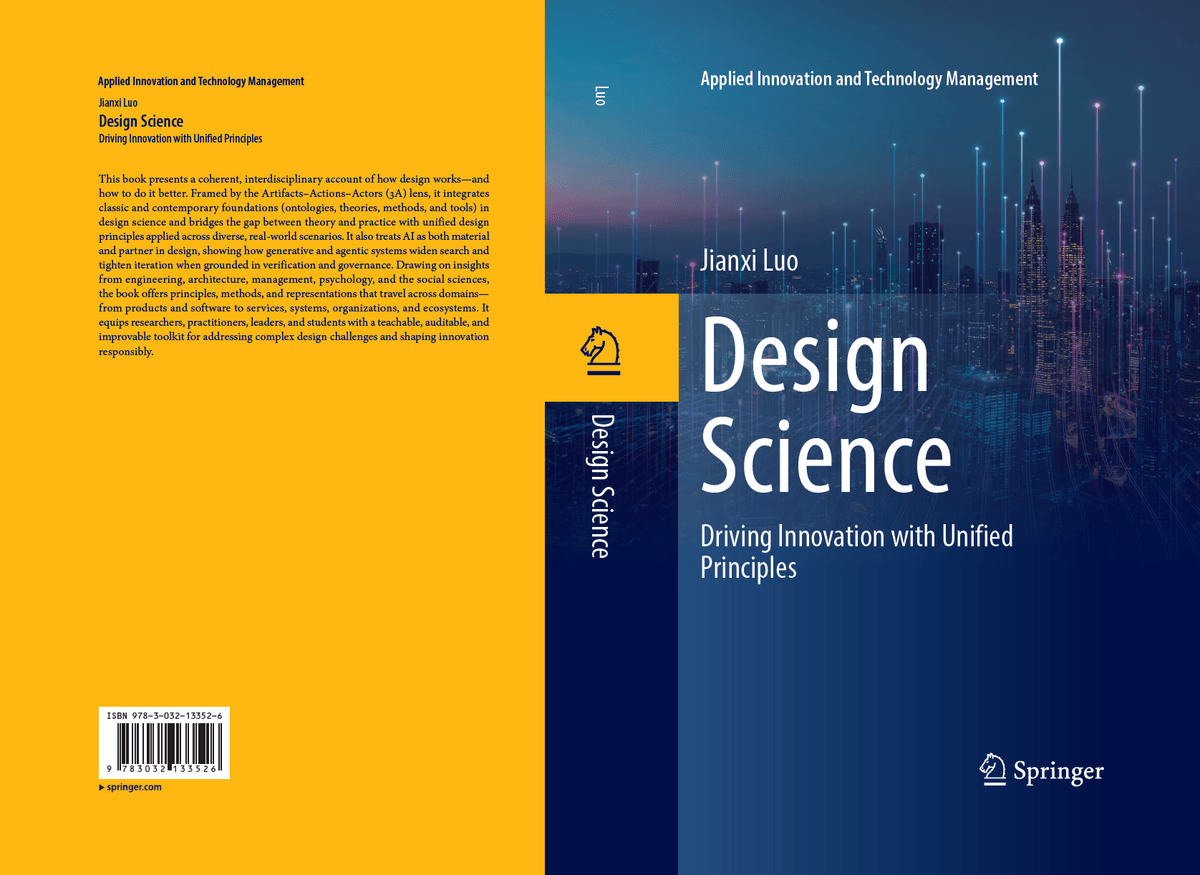
Driving Innovation with Unifed Principles
Design Science: Driving Innovation with Unified Principles
JIanxi Luo
2026
Book Synopsis
This book presents a coherent, interdisciplinary account of how design works—and how to do it better. Framed by the Artifacts–Actions–Actors (3A) lens, it integrates classic and contemporary foundations (ontologies, theories, methods, and tools) in design science and bridges the gap between theory and practice with unified design principles applied across diverse, real-world scenarios. It also treats AI as both material and partner in design, showing how generative and agentic systems widen search and tighten iteration when grounded in verification and governance. Drawing on insights from engineering, architecture, management, psychology, and the social sciences, the book offers principles, methods, and representations that travel across domains—from products and software to services, systems, organizations, and ecosystems. It equips researchers, practitioners, leaders, and students with a teachable, auditable, and improvable toolkit for addressing complex design challenges and shaping innovation responsibly.
Chapters
Chapter 1: Design Science - What Is It
This chapter defines design as the intentional transformation of knowledge into novel, useful artefacts and argues for a science of design that makes practice teachable, auditable, and improvable. Tracing key foundations and the emergence of Design Science as a field, it introduces the Artifacts–Actions–Actors (3A) framework as a unifying lens. We position design science as a meta-science for innovation, advancing unified principles that shift innovation from episodic luck to disciplined, repeatable progress across domains and scales.
Chapter 2: Design for Innovation
Innovation sits at the intersection of science, design, and entrepreneurship. This chapter articulates the United Innovation Process, showing how design translates scientific insight into testable inventions and prepares them for entrepreneurial scaling. Through selected cases and programs that illustrate integration at the individual, organizational, and ecosystem levels, we offer guidance on aligning incentives and value creation across actions spanning science, design, and entrepreneurship—to strengthen innovation outcomes.
Chapter 3: Design Process
Design rarely proceeds linearly. We compare human-centered models (IDEO, Double Diamond, d.school) with engineering and NPD frameworks (Pahl & Beitz, V-model, Stage-Gate, Lean Startup), then situate AI-augmented cycles (Double Hump) that widen search and tighten evidence loops. The chapter equips readers to select and hybridize processes based on uncertainty and cost of late change, emphasizing cadence (divergence/convergence), accountability at gates, and the importance of process literacy over one-size-fits-all prescriptions.
Chapter 4: Design Ontology
Ontologies make design reasoning explicit and computable. We survey four pillars—FBS, Axiomatic Design, C–K Theory, and TRIZ—plus complementary formalisms (DSR, GDT, OPM, Activity Theory). The chapter shows how functions, behaviors, structures, concepts, contradictions, and mappings encode design moves, support simulation and automation, and scaffold human–AI collaboration. Readers learn when and how to apply each ontology, and how ontological clarity improves traceability, creativity, and cross-team interoperability.
Chapter 5: Design Creativity
Creativity in design is the capacity to generate and realize ideas that are both novel and appropriate to purpose, context, and constraints. This chapter reviews levels of creativity, core cognitive mechanisms (abduction, analogy, recombination), and enabling conditions across individuals, teams, and organizations. We connect creative practice to evidence-seeking (prototyping) and decision-making (convergence), highlight the role of craftsmanship in making ideas real, and show how AI can widen search and accelerate iteration while human judgment guards meaning, values, and trade-offs.
Chapter 6: Design Empathy
Empathy evolves from user-centered usability to human-centered dignity and humanity-centered sustainability. We treat empathy as skill, process, and moral stance—supported by rigorous methods and reflexive practice that avoids “empathy theater.” The chapter frames limits and biases, then explores how AI can augment empathic reach at scale without replacing human care, emphasizing cultural sensitivity, accountability, and the embedding of equity and long-term stewardship in design criteria.
Chapter 7: Design Heuristics
Heuristics are fast-and-frugal strategies that guide action under uncertainty. We define what design heuristics are, why they matter under bounded rationality, and how they operate from framing through ideation to evaluation. A practical typology—form-, function-, behavior-, and system-based heuristics—helps designers move from open exploration to focused progress. The chapter also shows how to build an “adaptive toolbox” and demonstrates reflective use: naming, testing, refining, and combining heuristics with analysis.
Chapter 8: Design Prototyping
Prototyping turns speculation into evidence. We map modalities—physical, digital, service, and experience prototypes—and show how to choose the right fidelity to answer the next question fast. Craftsmanship is foregrounded: sketching, building, instrumenting, and refining in contact with materials, users, and constraints. With examples from additive-manufacturing-enabled iteration and data-rich testing, the chapter frames prototypes as boundary objects that align stakeholders, de-risk decisions, and accelerate learning.
Chapter 9: Design Flexibility
Change is the norm; flexibility must be designed, not left to chance. We present architectural strategies—modularity, loose coupling, platforming, and real-options thinking—and quantitative methods for valuing flexibility under uncertainty. Readers learn how to design evolvable interfaces and use staged commitments to keep future moves open. The chapter links flexibility to lifecycle costs, resilience, and faster adaptation in products, organizations, and policies.
Chapter 10: Design Convergence
Convergence is disciplined choice under constraints. This chapter structures multi-objective decision-making, verification/validation, and traceability from assumptions to evidence. We cover local vs. global optima, rugged performance landscapes, strategies for escaping traps, and selecting among alternatives via clear criteria. Heuristics are combined with optimization to stage tests that de-risk commitments. Throughout, we emphasize auditability—decisions that “hold in the world” because they are justified, reproducible, and aligned with requirements, values, and limits.
Chapter 11: Design Complexity
Complexity emerges from dependencies: structure governs behavior. This chapter equips designers to see and steer complexity using tools such as Design Structure Matrices (DSMs) and change-propagation analysis. We show how to expose hidden couplings, localize risk, partition architectures, and design interfaces that contain rework. Case patterns connect system architecture to emergent behaviors and sociotechnical coupling, offering tactics to align product, process, and organizational architectures so systems remain evolvable, testable, and governable.
Chapter 12: Design and Artificial Intelligence
AI is both material and partner. We show how generative and agentic systems widen search, tighten evidence loops, and scale analysis, prototyping, and evaluation—when embedded with goals, roles, guardrails, and escalation paths. The chapter covers data grounding, verification/validation, bias and safety, provenance from data to decision, and human-AI workflow design. The aim is dependable capability: systems that earn trust through transparency, testing, and governance.
Chapter 13: Design for X
Design extends beyond artefacts to outcomes. We develop “Design for X” across business (value capture and models), entrepreneurship (venture as designed system), public policy (legitimacy, equity, implementation), and sustainability (UN SDGs, circularity, life-cycle thinking). Methods include outcome-level requirements, market and policy experiments, and systems metrics (e.g., carbon, inclusion). The chapter turns “for X” into a method: creativity expansive, consequences legible and adjustable.
Chapter 14: Designing the Future
Returning to 3A with a systemic, evolutionary stance, we argue for artefacts as evolvable architectures (modularity, open interfaces, traceability), actors as human–AI constellations with participation and power designed in, and actions as instrumented, auditable, iterated interventions. We outline governance for learning at scale and ethical guardrails for AI-intensive systems. The chapter closes with practical principles for steering emergence—shaping futures that are innovative, accountable, and sustainable.
Inquiry
If you are interested in learning more about the Design Science book or getting a copy, please fill the form below. We will be in touch with you. Thanks!

Winter School on Design Science
8 - 12 January 2024, Singapore
The inaugural Winter School on Design Science (WSDS) was successfully held on 8 - 12 January 2024 at Singapore University of Technology and Design. The 5-day program was dedicated to exploring design theories and methods that transcend traditional boundaries, bridging the gap between design science and design practices across fields. WSDS attracted a global array of participants from esteemed universities like UC Berkeley, Imperial College, University of Melbourne, National University of Singapore, Tsinghua University, Shanghai Jiao Tong University, SUSTech and Sichuan University, engaging in intercutural and interdisciplinary learning and inspiration. WSDS emerged as a vibrant forum for envisioning the future of technology and design. A heartful thank you to all participants for their enthusiastic contributions and insightful discussions. We are excited about the future of WSDS and its role in advancing Design Science as a unified field of study.
Program


Opening

SUTD Campus Tour

Mingle with UC Berkeley students

7 Ways of Innovation
Huachao Gong

Designerly AI in Architecture
Immanuel Koh

Dinner at D'Star


Design Heuristics & Creativity
Jianxi Luo

Empathy in Design
Katja Holtta-Otto

Design Theories
John Gero

Dinner at Jumbo


Designers' Neurocognition
John Gero

Design Methods Research
Katja Holtta-Otto

Reconfigurable Design of Robotic Limbs
Fang Wan

Design Innovation with Gamification and AI
Aditya Batura

Design Science as a Meta Science
Jianxi Luo

Panel Discussion

Student Presentation
Zechuan Huang

Student Presentation
Zhoumingju Jiang

Student Presentation
Yilun Zhang

Student Presentation
Xudong Han

Student Presentation
Fuxi Ouyang

Best Presentation Award

Red Dot Museum Visit

Dinner at Haidilao


Design Theories & Methods
Jianxi Luo

Biomimetic Design
Hong Yee Low

Design for Additive Manufacturing
David Rosen

Digital Design & Manufacuturing Centre Tour

Dinner at Canopy


Large Language Models for Design
Shuo Jiang

Dyson Design Innovation
James Dyson Foundation

The Future of Technology and Design
Jianxi Luo

Company Visit & Closing
LionsBot
Gallery


